Showing posts with label Rain poem. Show all posts

Monday, May 18, 2020

XLIII.


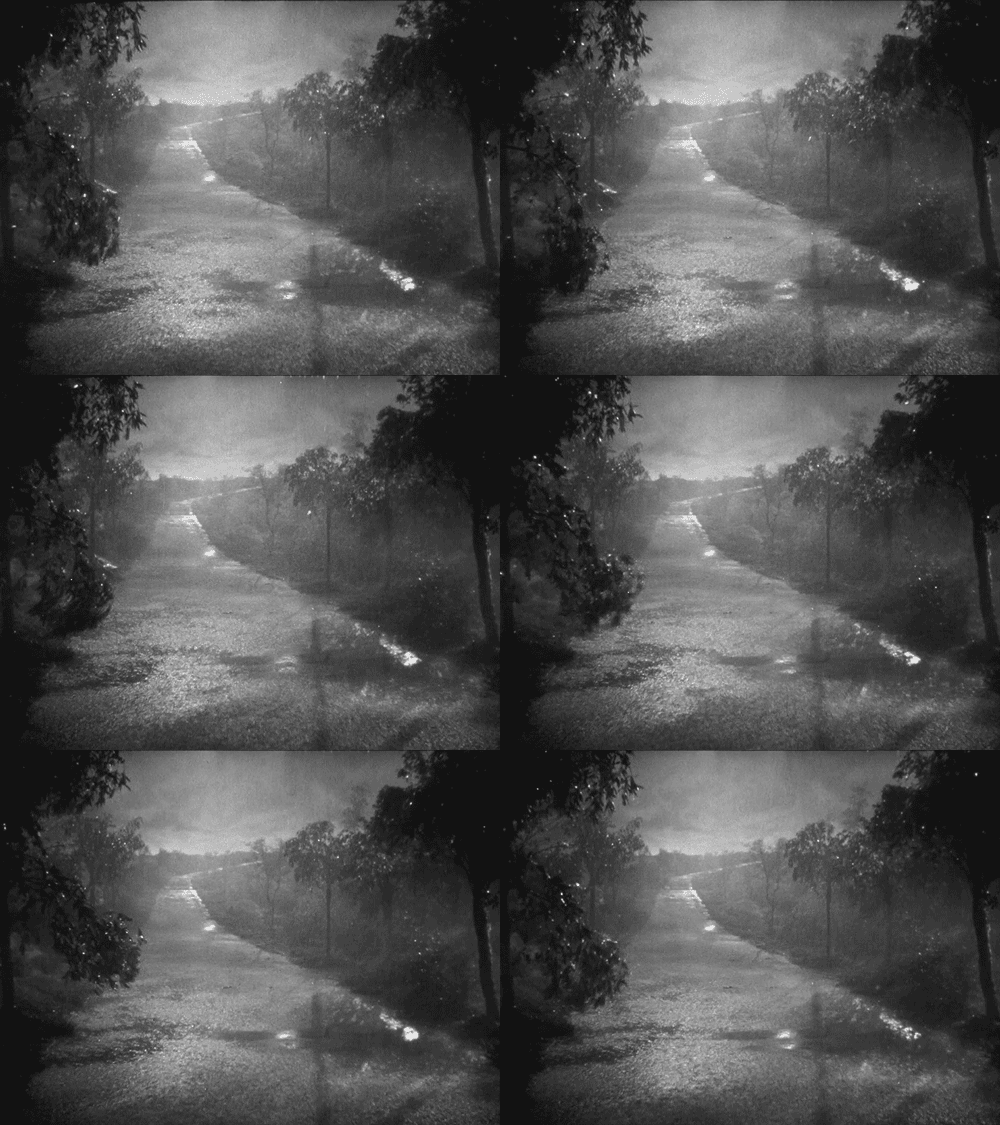
Summer Shower

A drop fell on the apple tree,
Another on the roof;
A half a dozen kissed the eaves,
And made the gables laugh.
A few went out to help the brook,
That went to help the sea.
Myself conjectured, Were they pearls,
What necklaces could be!
The dust replaced in hoisted roads,
The birds jocoser sung;
The sunshine threw his hat away,
The orchards spangles hung.
The breezes brought dejected lutes,
And bathed them in the glee;
The East put out a single flag,
And signed the fete away.

by
Emily Dickinson

This poem is in the public domain.
Photo credit: saturnine-stardust.tumblr.com

Monday, March 28, 2016

XXXV.


Like Rain it Sounded Till it Curved 

~by Emily Dickinson

Like Rain it sounded till it curved

And then I new 'twas Wind -

It walked as wet as any Wave

But swept as dry as sand -

When it had pushed itself away

To some remotest Plain

A coming as of Hosts was heard

It filled the Wells, it pleased the Pools

It warbled in the Road -

It pulled the spigot from the Hills

And let the Floods abroad -

It loosened acres, lifted seas

The sites of Centres stirred

Then like Elijah rode away

Upon a Wheel of Cloud.

Tuesday, December 22, 2015

XXXI.


Beloved, Let Us Once More Praise The Rain 
by Conrad Aiken


Beloved, let us once more praise the rain.

Let us discover some new alphabet,

For this, the often praised; and be ourselves,

The rain, the chickweed, and the burdock leaf,

The green-white privet flower, the spotted stone,

And all that welcomes the rain; the sparrow too,—

Who watches with a hard eye from seclusion,

Beneath the elm-tree bough, till rain is done.

There is an oriole who, upside down,

Hangs at his nest, and flicks an orange wing,

—Under a tree as dead and still as lead;

There is a single leaf, in all this heaven

Of leaves, which rain has loosened from its twig:

The stem breaks, and it falls, but it is caught

Upon a sister leaf, and thus she hangs;

There is an acorn cup, beside a mushroom

Which catches three drops from the stooping cloud.

The timid bee goes back to the hive; the fly

Under the broad leaf of the hollyhock

Perpends stupid with cold; the raindark snail

Surveys the wet world from a watery stone...

And still the syllables of water whisper:

The wheel of cloud whirs slowly: while we wait

In the dark room; and in your heart I find

One silver raindrop,—on a hawthorn leaf,—

Orion in a cobweb, and the World.

Friday, September 18, 2015

XXVII.


cul de sac

On this dark and pluvious evening,

I drew the curtain back,

to peer from my window discretely,

Looking down upon a dreary cul de sac.

Black lamps line granite streets, so neatly;

Seemingly intended for illumination,

but in reality, contributes to the bleak,

as it feeds the weak and desolation.

The rain showers are incessant, unending;

People move slowly and with hesitation.

They are dressed in black and grey,

I watch them pause and delay; as if in sedation.

With indifference, they survey each step,

casting a black silhouette, over wet walkways.

The outdoor conditions have worsened,

As I close the tatted lace curtain,

to inspect the room herein.

On the table of teak, lie confections sweet,

with roses and grapes nestled on a silver tray;

and the wine is chilling in a crystal vessel,

Intended for a party of two.

Yet, the door knocker has not knocked;

and the clocks have not stopped,

As I wait in vain for you.

The candles upon the mantle have receded;

my expectations have been defeated,

and the temperature has fallen from red to blue.

Instantly, the fruit upon the table appears decayed,

and I feel deflated and betrayed.

In profound disgust, the candle is snuffed;

and, like the weather external,

where clouds are black and nocturnal;

I am eclipsed of hope and illumination,

and in my wretched imagination,

I wear the eternal disguise of rain.


© Original poetry by Denise Goodwin, Lady Denyse and moonspyre.blogspot.com; 
All rights reserved.

Wednesday, June 3, 2015

XIII.

STILL FALLS THE RAIN
Dame Edith Louisa Sitwell, 1940


Still falls the Rain---
Dark as the world of man, black as our loss---
Blind as the nineteen hundred and forty nails
Upon the Cross.

Still falls the Rain
With a sound like the pulse of the heart that is changed to the hammer-beat
In the Potter's Field, and the sound of the impious feet

On the Tomb:
Still falls the Rain

In the Field of Blood where the small hopes breed and the human brain
Nurtures its greed, that worm with the brow of Cain.

Still falls the Rain
At the feet of the Starved Man hung upon the Cross.
Christ that each day, each night, nails there, have mercy on us---
On Dives and on Lazarus:
Under the Rain the sore and the gold are as one.

Still falls the Rain---
Still falls the Blood from the Starved Man's wounded Side:
He bears in His Heart all wounds,---those of the light that died,
The last faint spark
In the self-murdered heart, the wounds of the sad uncomprehending dark,
The wounds of the baited bear---
The blind and weeping bear whom the keepers beat
On his helpless flesh... the tears of the hunted hare.

Still falls the Rain---
Then--- O Ile leape up to my God: who pulles me doune---
See, see where Christ's blood streames in the firmament:
It flows from the Brow we nailed upon the tree

Deep to the dying, to the thirsting heart
That holds the fires of the world,---dark-smirched with pain
As Caesar's laurel crown.

Then sounds the voice of One who like the heart of man
Was once a child who among beasts has lain---
"Still do I love, still shed my innocent light, my Blood, for thee."


Dame Edith Sitwell was known for delivering dramatics, the most notable of which might be her practice of lying in an open coffin to prep for writing. -mentalfloss

Dame Edith Louisa Sitwell DBE (7 September 1887 – 9 December 1964) was a British poet and critic and the eldest of the three literary Sitwells.

Like her brothers Osbert and Sacheverell, Edith reacted badly to her eccentric, unloving parents, and lived for much of her life with her governess. She never married, but became passionately attached to the homosexual Russian painter Pavel Tchelitchew, and her home was always open to London's poetic circle, to whom she was unfailingly generous and helpful.